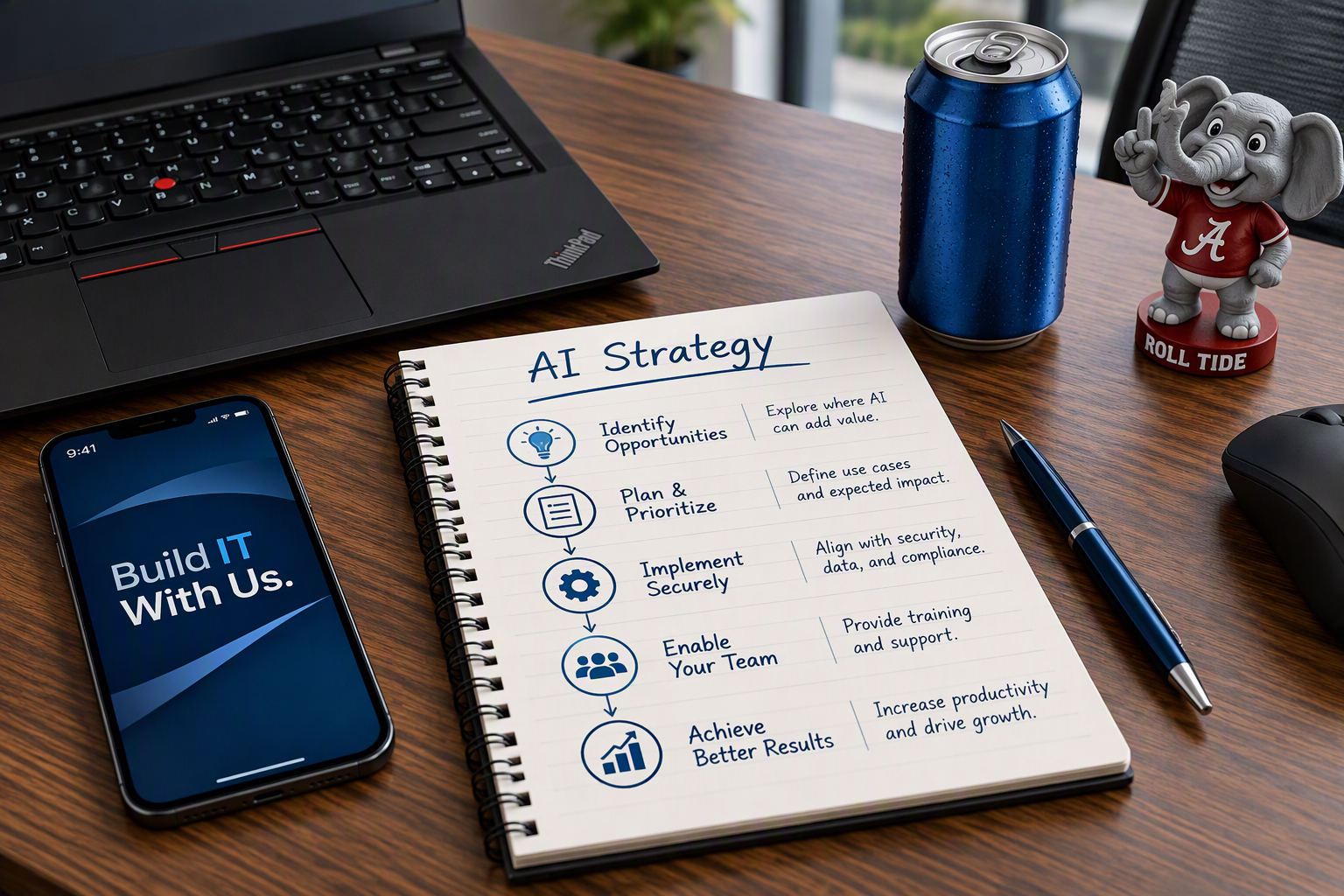
Artificial intelligence can help small and midsize businesses work more efficiently, improve customer experiences, and make better use of their information. But choosing an AI solution is not simply a software decision. It can affect how employees work, what company data is accessible, how information is protected, and what the solution ultimately costs.
Your managed service provider can help evaluate how an AI tool fits your existing technology, workflows, security requirements, and business goals. Effective AI planning starts by identifying the problem to solve, the systems and data involved, and how success will be measured, not by purchasing a tool and searching for a use afterward.
Security and privacy should also be considered before an AI platform is connected to company email, files, calendars, or customer information. Reviewing the vendor, understanding where data is stored, limiting access to what is necessary, and planning for monitoring and incident response are important parts of responsible implementation. Microsoft’s responsible AI guidance similarly emphasizes impact assessments, data governance, human oversight, and ongoing evaluation throughout an AI system’s lifecycle.
An MSP can also help clarify licensing, usage-based charges, integration requirements, backup needs, support responsibilities, and who will manage the solution after deployment. Without coordinated planning, businesses can end up with disconnected tools, overly broad data access, unclear ownership, unexpected costs, or solutions that do not fit the way employees actually work.
AI can create real business value, but the best results come from choosing the right use case, starting with a clear plan, and implementing the technology responsibly.
One of the best places to start is by creating a small AI workflow team made up of people who understand different parts of your business. This could include leadership, operations, finance, sales, customer service, and your technology partner. Together, the team can identify repetitive tasks, inefficient processes, and areas where employees spend too much time searching for information or manually moving data between systems.
But an important part of that conversation should also be:
Does this process actually need AI?
Not every workflow needs an AI solution. Sometimes traditional automation, better integration between existing systems, or simply improving the current process is the better, and more cost-effective. AI should be used where it provides a clear business benefit, not simply because AI is available.
Start Small, Prove the Value, Then Expand
Instead of trying to introduce AI across the entire organization at once, start with one or two well-defined workflows.
Identify a Business Need → Review the Workflow → Determine if AI is the Right Tool → Protect the Data → Run a Controlled Pilot → Measure the Results → Expand
Starting small gives your organization an opportunity to understand the technology, establish appropriate security controls, measure the results, and learn how employees will actually use it before making a larger investment.
Your MSP can play an important role throughout this process by helping your workflow team evaluate the available technology, understand how AI will interact with your existing systems and data, review security and licensing requirements, and determine whether AI, traditional automation, or another solution is the best fit.
Before adopting your an AI solution, talk with us about your AI strategy. We are here to help you evaluate the options and move forward with confidence.
At TUSCOM, we are here to be a trusted resource as you build that strategy helping your team understand the options, ask the right questions, and find practical opportunities where AI can make a meaningful difference in your business.