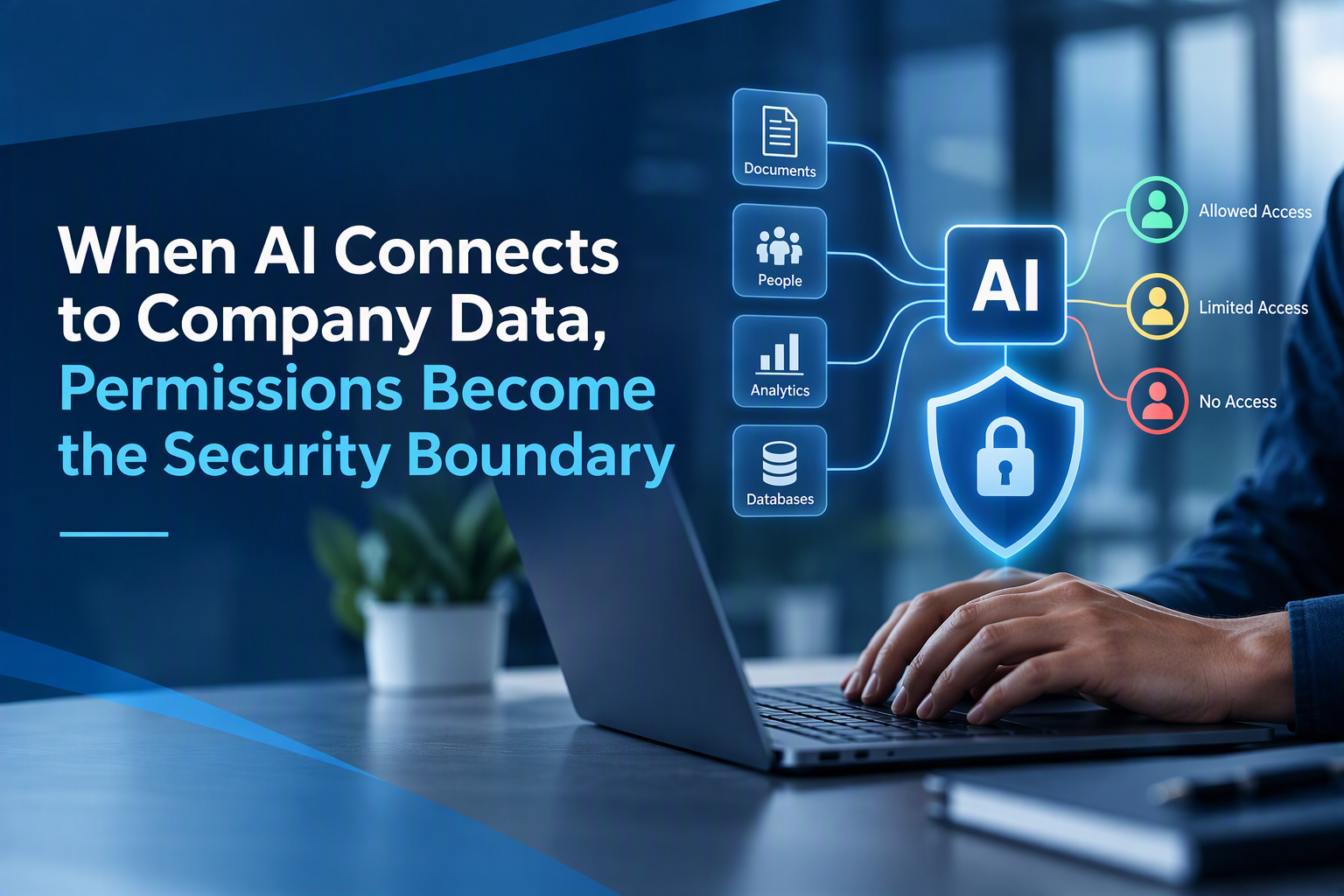
An AI assistant that only receives a manually entered public prompt presents a different risk than an agent that can read mail, search SharePoint, modify documents, create meetings, or send messages.
The safest approach is least privilege: provide only the access required for the approved business purpose.
For one AI-enabled workflow reviewed by TUSCOM, the design limited an application to a single shared mailbox rather than allowing it to read every employee’s mail. The application used only the specific read-and-send permissions required for that workflow. The design also called for separate API keys by client, encryption for confidential drawings, restricted access, retention controls, off-box backups, restore testing, patching ownership, and monitoring.
Those controls are not limited to large enterprises. SMBs should establish the same fundamentals:
- Identity and access: Require business accounts, multifactor authentication, role-based access, and approved administrator consent.
- Least privilege: Limit connectors and applications to the smallest practical set of users, mailboxes, sites, files, and actions.
- Data classification: Decide what may be entered into approved AI tools and what must remain prohibited or restricted.
- Vendor review: Review the provider, application developer, hosting model, subprocessors, security documentation, and current contract terms.
- Retention and deletion: Define how long prompts, uploads, outputs, logs, and generated records should remain available.
- Monitoring: Track approved tools, user access, unusual activity, consumption, incidents, and connector changes.
- Human review: Require people to validate important outputs and approve consequential actions.
- Shadow AI controls: Give employees an approved option and a clear policy so they are not forced to improvise with unmanaged consumer accounts.
Microsoft’s AI security guidance likewise emphasizes privacy obligations, data-residency boundaries, and protection of sensitive business data. NIST’s AI Risk Management Framework provides a broader structure for preserving AI’s benefits while identifying and mitigating risks in a way that supports business needs.
TUSCOM helps SMB leaders evaluate AI in the context that matters most: their business goals, existing systems, company data, cybersecurity posture, employees, and budget.
You do not need to be an existing TUSCOM managed-services client to start that conversation. TUSCOM can help your organization:
- Identify practical AI opportunities
- Compare Copilot, ChatGPT, Claude, Gemini, and specialized tools
- Review consumer, business, enterprise, and API differences
- Understand requested application permissions and connectors
- Evaluate data-use, retention, privacy, and security terms
- Estimate licensing, token consumption, credits, and long-term cost
- Design a controlled pilot
- Develop AI acceptable-use and governance recommendations
- Plan a broader, responsible AI strategy
AI can create meaningful value for small and midsize businesses. The goal is not to slow adoption, it is to make adoption informed, secure, financially sustainable, and aligned with the business.
Ready to explore AI for your organization?
Talk with TUSCOM Technology Solutions. We are here to help you compare the options, protect your business data, understand the real costs, and develop an AI strategy that fits your organization.